
Following the floods in Nepal that devastated part of the country on Wednesday, August 26, 2026, Maya Verbist, Planète Enfants & Développement’s Director in Nepal, has been providing us with regular updates.
Update as of September 28, 2026
A month later, the full extent of the disaster continues to unfold. According to the latest report from Nepal’s National Disaster Risk Reduction and Management Authority (NDRRMA), the official death toll stands at 1,453, while 5,285 others are still missing. Search and rescue operations are ongoing. These efforts are being carried out by specialized teams—international forensic experts from India, China, South Korea, Singapore, and the United States—who are working to recover the remains and identify the victims through DNA testing.
Travel and Lodging
1,109 people remain housed in 21 temporary shelters located in Rasuwa, Nuwakot, and Dhading. For families who prefer not to stay there, the government has begun providing a monthly housing and living allowance until permanent reconstruction is completed.
Weather and Directions
Continuous rain in the affected districts has slowed relief efforts and repeatedly disrupted access to isolated communities. Roads and bridges remain the main obstacles: 41 bridges were destroyed during the initial flooding. While zip-line crossings have been set up in Devighat, Indreni Chaur, and Syafrubesi, repairs to the other suspension bridges are still underway. Many areas—particularly parts of Rasuwa and remote sectors of Nuwakot—remain accessible only by zip line, helicopter, or on foot.
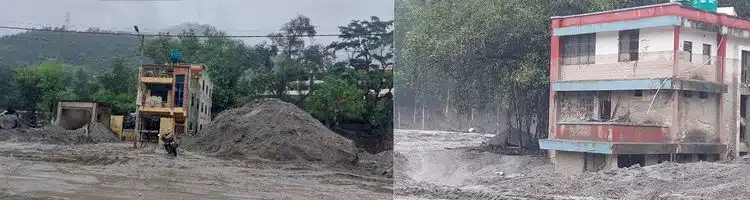
On the road between Kathmandu and Gorkha, September 24, 2026 – Buddi Shresta for Planète Enfants & Développement
Making matters worse, a separate low-pressure system that formed over the Bay of Bengal brought heavy to very heavy rains to much of Nepal from September 24 to 27, causing further flooding and landslides well beyond the initial disaster area. Districts such as Manang, Mustang, Myagdi, and Baglung were severely affected: bridges were damaged, roads were cut off, and villages were cut off by rising waters. In Kathmandu, rising water levels in the Bagmati River and other waterways forced the evacuation of families living in riverside settlements. Nationwide, this storm has caused at least 21 deaths and the displacement of approximately 3,000 people from high-risk areas. This renewed rainfall has further complicated relief and rescue operations and overwhelmed already very limited logistical capacities and road access.
Planète Enfants & Développement and Chhori: On the Ground in Nuwakot and Dhading
Thanks to your support, we raised 8,950€ for the first phase of emergency aid carried out by our local partner, Chhori. Thank you very much. I provided details on how the funds were used in my update from September 10.
The combination of emotional and material support we can provide reflects what our teams are seeing firsthand on the ground: recovery isn’t limited to rebuilding homes and roads; it’s also about restoring a sense of security, routine, and dignity to children and women who have been displaced for weeks.
We are therefore planning the following two phases:
- Between November 2026 and April 2027, we plan to reestablish safe and stable learning environments for children ages 3 to 8, with psychosocial support for both the children and their educators.
- Between May 2027 and April 2029, we plan to adopt a «build back better» approach in a targeted rural municipality—most likely in Nuwakot District or the rural municipality of Sahid Lakhan (Gorkha District)—by strengthening child protection and education for children from kindergarten through third grade over a two-year period.
Together, the three phases will form a coordinated response—from emergency assistance to sustainable resilience and structured recovery—designed to complement, rather than duplicate, the Nepalese government’s relief and reconstruction efforts.
👇
Update as of September 15, 2026: Moving Toward the Rehabilitation Phase
The population remains in a state of shock
Field assessments reveal severe signs of trauma among survivors: shock, withdrawal, physical and psychological exhaustion, and anxiety attacks.
Young children are particularly vulnerable. The trauma of the event and the sudden disruption of their daily routines and family life threaten children’s well-being and health if psychosocial support is not provided promptly.
Between October and next April, Planète Enfants & Développement and Chhori plan to:
- restore stable environments in schools and temporary learning centers,
- strengthen the capacity of parents, guardians, and teachers to support the emotional healing of children directly affected.
A project targeting 360 children and 240 parents, guardians, and teachers in the districts of Rasuwa, Nuwakot, Dhading, Gorkha, and Tanahun; the project requires €52,800.
How will your donation be used?
- €20 = school supplies for 1 child
- €88 = the complete kit to restore balance for one child
Many children today are separated from their parents. The school environment must become a source of stability and healing.
Thank you very much for any support—no matter how small—that you can provide to help us achieve this goal.
👇
Update for September 10, 2026: Our Response to the Emergency
In the days following the disaster on August 26, we joined forces with our local partner, Chhori.
Thanks to your generosity, we have raised nearly 9,000€, which has enabled us to take the following urgent actions:
- to distribute clothing and hygiene products, as well as bags to carry their belongings, and to provide psychological support to 119 people at a community center in Nuwakot.
- to provide clothing, food, blankets, etc., to 125 people at temporary shelters (in Galaundi and Ratmate).
- to distribute school supplies and provide psychological support to 160 children in Gajuri, Dhading, at the request of the schools, in order to help the children maintain a routine amid the chaos.
A huge thank you for your support during this first stage.
Update as of September 1, 2026
Following the landslides that occurred in Nepal last Wednesday, the Trishuli and Lhende Khola rivers burst their banks, sweeping away everything in their path over a distance of nearly 100 kilometers in Bagmati Province.
The toll is tragic and is rising every day.
The destruction of roads and bridges, combined with unstable ground conditions, makes it difficult for emergency vehicles to reach the area.
The main road connecting Kathmandu and Pokhara has collapsed. It will take at least one month to restore it to service.
The Chepang teenage girls we are following are safe and sound, as are their families. But they are stuck inside the boarding school, feeling anxious.
It is extremely hot, the monsoon season is in full swing, there is a shortage of drinking water, and people fear disease. That is why rescue workers and authorities are burying the bodies they find by the hundreds, without any way to identify them. The psychological impact is immense and indescribable.
The Urgent Need on the Ground: Protecting the Most Vulnerable and Mitigating Trauma
In the districts of Nuwakot and Dhading, 2,700 people are currently being housed in temporary shelters run by the military.
Hira, the director of our long-standing partner Chhori, visited the site this weekend with her team. She tells me that the survivors are in shock, completely exhausted, and overwhelmed by grief and anxiety.
Children and women who find themselves alone are now at risk of violence, exploitation, and trafficking.
Our response: Support Chhori’s immediate action
Chhori’s team of counselors and social workers (Maiya, Hira, Mira, Komal, and Apsara), supported by the Chepang adolescent leaders trained through our project, are already on the ground in the municipalities of Bidur, Uttargaya, and Gajuri.
Working in coordination with local authorities, they provide essential initial material and psychological assistance.
How will your donation be used?
We urgently need to raise €10,000 to help Chhori provide direct support to 160 children and women, as a first step, in the emergency camps.
Today, thanks to the generous support of 35 of you, we have raised €2,765. Thank you.
- 35€ = 1 emergency kit
(clothes, diapers, food, as well as a bag and toys for the children.) - 65€ = individual psychological counseling and material support
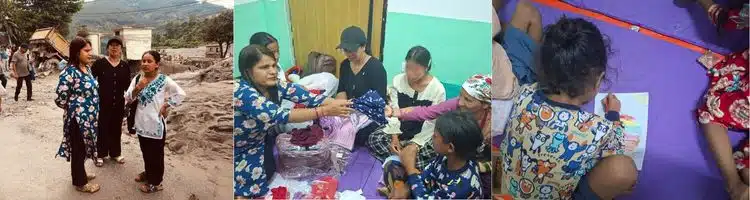
Your generosity is essential. Every donation, no matter the amount, will provide vital comfort and practical assistance to children and women in need.
We would like to express our heartfelt thanks in advance for your loyal support and solidarity with the people of Nepal during this very difficult time.
To help, you can contribute to the Nepal Fund we've set up 👇
Update as of August 31, 2026
«The situation in the disaster-stricken region remains serious. The death toll now stands at more than 750, and more than 2,000 people are still missing. The scale of the rescue operation is enormous: more than 9,400 people have already been rescued, nearly 400 humanitarian flights have been carried out, and more than 20,000 security personnel have been deployed on the ground.
At the same time, Nepal’s foreign minister is calling on the international community to step up its efforts to address climate change. Nepal contributes virtually nothing to greenhouse gas emissions, yet it pays one of the heaviest prices. This is an injustice that must not go unaddressed.
Another notable development: Nepal is rallying together. The government, the military, volunteers, IT professionals, and civil society organizations—everyone is finding their place in the puzzle to do their part. «
After the emergency phase comes the reconstruction phase.
To help, you can contribute to the Nepal Fund we've set up 👇
Update: Day 3 After the Floods
»The situation in the affected region remains serious, and the full extent of the disaster is becoming clearer with each passing day.".
To date, at least 626 deaths have been confirmed, and thousands of people are still missing. Dozens of bridges have been washed away, approximately 40 kilometers of roads have been destroyed, and entire communities are cut off from the outside world. Access remains extremely difficult, even for helicopters.
Rescue and relief operations are being coordinated by the Nepalese government, the military, and security forces. Every day, dozens of helicopter flights are carried out, and thousands of rescue workers are mobilized. The authorities’ response has been impressive so far, given the enormous challenges on the ground.
We are monitoring the situation closely and are already looking further ahead.
Because after the rescue phase comes the long-term reconstruction.
Helping families get back on their feet, enabling children to return to school, and rebuilding communities. This requires targeted, small-scale, long-term support. «
To help, you can contribute to the Nepal Fund we've set up 👇