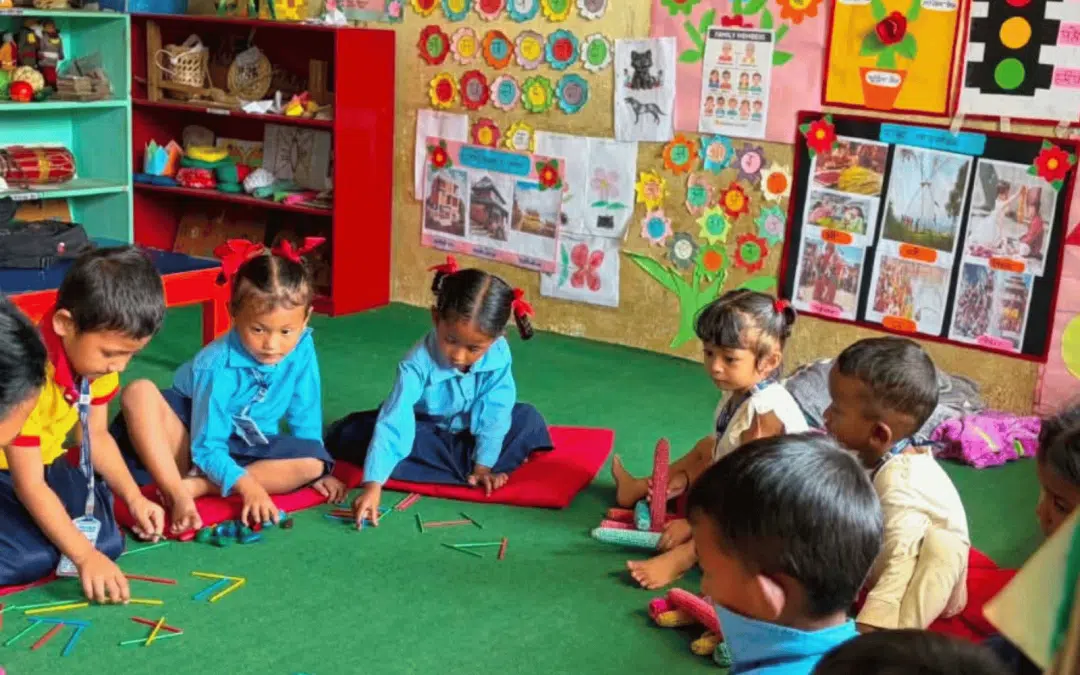
Finding a safe, professional, and affordable solution for childcare remains a real challenge in Cambodia. Between February and May 2026, Planète Enfants & Développement conducted a study in Phnom Penh and Siem Reap to provide a clear picture of the current situation, with support from CAPRED (the Cambodia-Australia Partnership for Resilient Economic Development) and the Sancta Devota Foundation. The needs are immense, but the available options remain scarce, expensive, and uneven.
A country on the move, where children often stay at home

Factories are running, mothers are working more and more, and yet barely more than 3 out of every 100 children under the age of three are enrolled in a formal childcare facility. Most families make do in other ways: grandparents, older sisters, neighbors. This is a stopgap solution, but it doesn’t always provide the safety, stimulation, and supervision that a toddler needs.
Private daycare centers and those located in factories do exist, but they are concentrated in Phnom Penh. In the provinces, they are virtually nonexistent.
It was in this context that, between 2020 and 2023, we developed a model for community-based daycare centers that is now recognized by the Ministry of Education: 13 such centers are already operating in Kampong Speu and Kampong Cham.
Laws that exist but are rarely enforced
Cambodia did not wait until 2026 to enact legislation. The Constitution itself stipulates that the state must assist mothers and children. Since 1997, the Labor Code has required companies with more than 100 workers to provide childcare services. A recent regulatory text, Subdecree No. 254, even sets minimum standards: suitable facilities, one adult for approximately every six children, hygiene, safety, and so on.
But in practice, many employers prefer to provide a small allowance rather than open a full-fledged daycare center. This allowance rarely exceeds $20 per month, which is far from enough to cover the actual cost of childcare.
Why are there so few daycare centers, even though there's a law requiring them?
The factory owners we interviewed cited several obstacles: construction and operating costs, a lack of technical support to get started, and, above all, the difficulty in recruiting qualified staff. Currently, there is no recognized training or certification program to become a childcare assistant in Cambodia. Most of the people hired learn on the job, with just one or two days of training, before they begin caring for the children.
Salaries are low—ranging from $200 to $500 per month depending on the organization—which does not help attract and retain motivated staff.
Parents also lack confidence. Many would rather leave their child with a relative than with a stranger—even one who is trained. Transportation is also an issue: when you have to rely on uncomfortable public transportation to get to the factory, it’s hard to bring your child along.
When Childcare Becomes Good for Business
The most interesting finding of our study is that childcare is not just a social expense—it’s also profitable. The five factories we surveyed all reported positive effects on their operating results: lower employee turnover, fewer absences, and a better reputation among international buyers.
The problem is that none of these factories accurately measures these gains. The study therefore had to rely on national data from the textile sector to estimate the savings achieved through a daycare center: lower employee turnover and reduced absenteeism. The result: depending on the assumptions used, a factory that invests in a daycare center can recoup that investment in 4 to 10 years.
A World Bank study* goes even further: every dollar invested in child care in Cambodia is estimated to yield up to $8 in economic and social benefits, taking into account employment, income, health, and children’s development.
What Planète Enfants & Développement offers:
To improve the situation, we propose several approaches:
- Simplify and enforce the rules through inspection visits and practical support for daycare centers.
- Offer financial assistance to employers: grants, tax breaks, and technical support to build and equip a daycare center.
- Establish and recognize the profession of early childhood care worker, with a certification pathway and a decent salary (around $350–$400 per month, considered more fair given the responsibilities).
- Reassure parents by explaining the benefits of a well-run daycare center for a child’s development.
- Find solutions to the transportation problem, such as vouchers for use at local daycare centers or supervised and regulated in-home childcare.
Cambodia has laid the legal groundwork for a child care system, but it still lacks the resources and expertise to implement it nationwide. Investing in this sector would benefit children as well as families, businesses, and the country’s economy as a whole.
* Study titled “Investing in Childcare: A Social and Economic Cost-Benefit Analysis of Government and Employer-Supported Models in Cambodia” – 2026 – World Bank Group