

Cambodia
Early Childhood Development 2020-2022 | 2023-2026
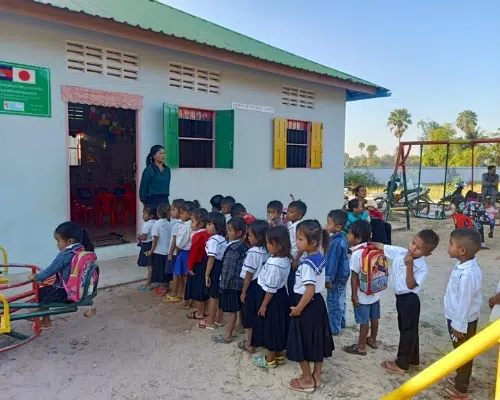
100 community preschools standardized for children's education
In Cambodia, only 25% of children aged 3 to 6 are enrolled in preschools. Public schools are rare in the countryside and the poorest municipalities do not have the means and skills to manage their communal schools.
Share this project:


Support us:
The context
To improve children’s education in Cambodia and, in particular, to address the shortage of public preschools in rural areas, the Cambodian government has promoted an alternative model of community preschools managed by village councils: they are easier to establish and less expensive. Planète Enfants & Développement and UNICEF were the first to develop this, in the late 1980s, low-cost alternative model to public schools, managed at the community level. We have created 200 community kindergartens across the country.
In 2006, the Cambodian government recognized the model through the adoption of an official program for community schools and training for female teachers (98% of the teachers are women, poorly trained and poorly paid). In 2008, the Decentralization and Deconcentration Law (D&D) delegated the implementation and management of preschool to the communes. It has also created Commune Councils for Women and Children (CCWC) specialized in social affairs. A major turning point for the country and for our projects.
How is your donation used?
For every €100 raised by Planète Enfants & Développement, €86 goes towards our social mission.
Our projects are evaluated by independent firms. And our accounts are audited and certified each year by KPMG.
The project
This project builds on 30 years of research and experience by Planète Enfants & Développement in the field of early childhood education and aims to improve children’s education in Cambodia. Its goal, therefore, has been to reduce inequalities in access to education between children in rural and urban areas, as well as to support fair compensation for teachers and mothers.
Phase 2020–2022: 100 schools up to standard
Planète Enfants & Développement and its local partner, Bandos Komar, have, in 100 villages in the provinces of Kampot, Kampong Speu, Sihanoukville, and Pursat:
- funded the construction of 57 new schools and the renovation of 43 preschools.
- supported and trained teachers, local councils and school management committees to improve their operations and meet the quality standards required by the government for certification,
- provided gender awareness and advocacy sessions for the 100 women teachers involved in the project.
Phase 2023–2026: Continued support for 51 public schools
Since 2023, we have been taking this commitment to the next level by working with 51 of these preschools to make tangible improvements to the quality of classroom learning. We provide individualized coaching for teachers in the classroom, delivered by our four early childhood supervisors.
Coaching is based on classroom observation, with a particular focus on space management, learning through play, improving the school environment, and gender equality practices. In particular, we conducted an initial analysis of gender stereotypes that may be perpetuated in schools. The analysis grid is based on approximately 40 points, such as “The teacher encourages mixed-gender participation in activities,” “Boys and girls share the playground equally,” “Boys and girls help the teacher in the same way” after activities or at the end of class… We have already noted that 44 teachers achieved a higher score and improved their practices between the first two sessions. We also provided them with an online platform of teaching resources to support them in preparing their activities. The satisfaction survey conducted afterward indicates that more than half of the teachers use it at least once a week and that 90 % report finding useful information there.
A external evaluation report A report published in July 2026 confirmed the impact of this support in the field:
- 100 % of the early childhood professionals surveyed reported that they had changed their interactive and play-based learning methods as a result of the training and coaching. The traditional textbook-based approach has given way to an active teaching method tailored to each age group.
- 100 % teachers report that they have shifted toward gender-neutral practices by adapting their choice of stories and toys and the distribution of activities to eliminate all forms of discrimination.
- More than 90 % educators have observed a tangible improvement in physical health practices. Handwashing, brushing teeth, and sorting waste are now fully integrated into the children’s daily routines, both at school and at home.
Our partners in the field
Bandos KomaA : Cambodian association specialized in the development of early childhood and the improvement of the quality of primary education in Cambodia.